Showing posts with label Ministry. Show all posts

Tuesday, April 1, 2014

Worshipping a Differently-Abled Christ

Each Masters Senior at Princeton Theological Seminary is eligible to give the message during the weekday service. I gave my message on April 1. If you want to listen to the sermon or the whole service, you can. Here is the link to the sermon and the service before and after the sermon.

The passage for this sermon is John 9:1-5

Throughout my life I have been trying to understand why I have a speech impediment. Why did God do this to me? At first I thought it was a curse done to me because of past sins; just as the Disciples ask Christ about the man who is blind. Then I wondered for some time if it was a prank on me. One day, I would wake up and this impediment would be gone. Jesus would be appearing more like Buddy Jesus from the movie Dogma and He would say “April Fools!”

Most of my life, I longed for that day to be whole, to feel whole. Why God? Why am I not whole? Then throughout seminary I have tried to reconcile my speech impediment through looking at it as a gift, as Jesus seems to proclaim in John 9. Christ must have meant for this to happen. A way to use me in the world. In wrestling with this, I have come to see that this too is not true. Being a person with a disability is not a gift nor is it about sin. I have realized the reason that I have felt like an outcast has nothing to do with my relationship with Christ. The source of my pain has been the reactions of my fellow brothers and sisters in Christ here on Earth.

Part of Jesus' witness in the Gospels is about restoring outcasts to their communities. The Ecumenical Disability Advocates Network contends that “The healing stories in the gospels, [like John 9] are primarily concerned with restoration of persons to their communities, not the cure of their physiological conditions.” This man who was blind was not welcome in his community and is only restored to his community after the miracle.

Furthermore, at the end of this story, Christ proclaims that people who can physically see are spirituality blind. Then the inverse must be true: People who have disabilities can be spiritually whole. This speech impediment is just a part of who I am, not a sin, not a gift. Our collective sin have been trying to reach an unrealistic perfection while living in an imperfect world.
  • Let's remember: We are asked to live faithfully, not sinlessly. 
  • Let's admit: We as humans err a lot. 
  • Let's confess: We will not be perfect as it is currently defined in the modern world. 
Lent is an ideal time to think about this restoration. The theologian Lisa Eiesland writes in Disabled God that after the resurrection in Luke, Christ appears with injuries to His hands and feet. By doing so, she claims that Jesus' disability indicates not a flawed humanity but a full humanity. 

By acknowledging this truth that we worship a God who is differently abled and yet still whole, we can admit that our faithfulness, not our perfection, bring us into the body of Christ. Therefore, the resurrection in two and a half weeks is a collective restoration for all of us. We each have different abilities and struggles. We all have gifts to offer each other and the world. 

Let me caution you all today too: People with disabilities are not here for abled body people to feel blessed or feel lucky. We are not here for others' self-realizations. We are here to be active parts of the body of Christ and to offer our own gifts and talents to the world. Attitudes of pity, judgement, and fear of people with disabilities interfere with this restoration. 

 This is the Good News! On Easter, we, as an imperfect people, will be restored back into this whole living differently-abled body of Christ.

Sunday, March 30, 2014

Lenten Reflection

I wrote the following as an entry in the Princeton University Chapel Lenten Meditation Booklet. I was assigned the following text: Matthew 5:1-12 (The Beatitudes)

Doesn't Jesus make the Beatitudes sound so easy? Who wouldn't want to live in these ways?

Just follow these simple words and you will be blessed by the Lord. Why would it not be easy?

Yet we all know that these words, easy as they sound, are a lot harder to live out. At Jesus's time, in the First Century AD, people of faith had become lax in their devotion and practice. Social injustice was abound in a community that claimed to worship God.

Doesn't that sound familiar? Look at our current world that is ravaged by a lot of societal ills, such as mass incarceration, war, gun violence, increasingly economic inequality. Our worship can sometimes become rote, instead of having spiritual richness. In many ways we are currently in a similar position as First Century Israel.

To confront this communal sin, Jesus issues a call for His followers to go deeper in faith. He issues standards of devotion that God expect out of the new followers. These same standards are still relevant today. Christianity is not supposed to be something that is only relegated to Sunday mornings. Instead, our faith should be lived out in our everyday actions.

Yes this is hard to do! Another thing about the Beatitudes: Jesus was talking to His Disciples, not to a single person. We cannot do this alone, separate from each other. As a faith community we should work together to improve the world around us, so we can all be blessed, not just some of us. But this work of transformation must begin with us.

This first step in this transformation is to support each other and hold each other accountable to live deeper into our faith to strive to be like the examples Jesus expresses in the Beatitudes.

Friday, November 22, 2013

Do We Worship God or America?

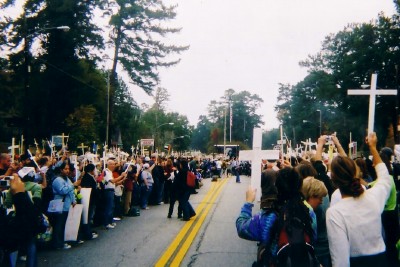
This weekend is the annual protest against the Western HemisphereInstitute for Security Cooperation, formerly known as the School of the Americas, located at Fort Benning, Georgia. This military institute has been known to train Latin American general in brutal tactics that have been used to silence the opposition in numerous ways. Some of the victims have been Catholic priests and nuns working alongside the poor.

Photo by Patrick Mulvaney of 2004 SOA Protest Funeral Procession
Read his recount here
The vigil is held the weekend before Thanksgiving annually to commemorate the anniversary of the deaths of 6 priests, theirhousekeeper and her daughter in El Salvador on November 16, 1989, just eight people of the thousands killed by the graduates of SOA. About 15,000-20,000 people will attend this vigil. School groups, college groups, peace activists, Catholics, and Protestants from the US and Latin America comes to peacefully protest this institute. I went twice with fellow classmates from Earlham College. Every year the vigil ends in a giant funeral procession remembering all the people who have been killed by the graduates of the School of the Americas.

Yet, outside of a handful of Catholic and Protestant churches, will this protest get any attention this Sunday in our churches? How many churches will remember the victims of our military actions in their prayers of the people? Will there be any special services to commemorate this ongoing suffering tragedy?


I want to contrast this with what I saw earlier this month all over social media, in the news and with my own eyes. On the Sunday before Veterans Day, there were special services, invitations to military families, and prayers for our troops. Here is just one of many examples: Rick Warren's Saddleback Church had a special invitation to military families.
When will Saddleback Church make a special invitation to peacemakers and their families? Or any church for that matter?

When will churches give prayers for the victims of war in the Prayers of the People? When will we remember the deaths of our fellow Christians or even humans affected by our extremely large military? Even more, when will we recognize that we are all complicit with the military industrial complex that feed off a patriotic Christianity in the United States? This is one of our sins that we need to recognize!

I have seen pastors who are worried about saying anything to disrupt their congregants on Veterans Day weekend. If they didn't want to glorify war, most of them stay silent and did not mention their real beliefs. Veterans Day weekend in the Church should have been one of mourning. Yes, mourning that the War to End All Wars did not do accomplish that. Instead it continued a brutal and violent history. We should mourn how we so eagerly send off young people to fight to keep the Defense Industry wealthy, while we ignore veterans on the streets?

Sadly American Christianity is currently more interested in upholding American Exceptionalism rather than having a prophetic voice. When will we recognize that God does not just love us but the whole world? Until that point, American Christianity will continue to worship America more than God.  

Sunday, March 17, 2013

The Unpredictability of March

A couple weeks ago, I attended the meeting for worship at Princeton Friends School, which the school calls "Settling In". Each week they meet for 30 minutes and a student offers a query. Since it was the first day of March, the assigned student asked "What are you looking forward to in March?"


Students talked about upcoming birthdays, looking forward to playing outside more, and summer coming closer. They were ready to shed their winter clothes and activities for sunny days spent outside. Eighth graders expected to hear back from high schools soon and they were nervous and eager to find out where they were accepted. These students were eager to take the next step in their education and life.


One of the teachers stood up and talked about how March could bring different weather. In March it is still normal for there to be a late snowstorm he said, but we also could expect sunny days to happen where short sleeves can be worn and bike riding could be done. The theme of his message was that March brought unpredictability, at a time when we wanted something concrete, ie the end of Winter and the start of Spring or the end of one stage of life and the becoming of another. We know that Spring is coming and we will hear about where we go on the next stage of our life, but March always brings surprises and bumps along the way.
---

In my experience this rang true. I used to go to New Orleans in March from Washington DC with a group of high school students for an alternative spring break trip. I remember often times bundling up to go to the airport in DC and then shedding all the layers once we landed in New Orleans. New Orleans was usually sunny with highs in the 70s and 80s that week in March. It gave us our first glimpse of Spring that helped us make it through the last few weeks of a DC winter/early Spring when we returned home. We were given a chance to see what was awaiting us once we waited out the dreadful last weeks of the winter season.


But that was not always true. Once I remember arriving to the airport in DC when it was in the 70s there. Instead of the group all wearing shorts and T-shirts in preparation for warm weather to follow us, we were carrying jackets and coats while wearing jeans. I actually expressed concern for two students who arrived with shorts on. "Did you come prepared? Did you look at the weather forecast?" Once we landed in New Orleans, it was a different than other years. It was cloudy with a high in the upper 40s. That night the temps dipped down to about freezing. We were cold that night sleeping in the not well insulated dorm room. It did warm up by the end of the week, but it seemed strange.
---

A week later after the Settling In worship, I was reminded of the teacher's words. A small snowstorm dumped a couple inches on Princeton, ruining any plans for bicycling or playing outside. It was beautiful and Princeton looked more like it was early January than early March. Jenn and I would have appreciated the snow more if we weren't in a hurry to make it to DC. We left that morning instead of the night before due to forecasts of snow. Yet, despite the weather forecasters' predictions, the snow came that morning.
The unpredictability of March caught us and we were not prepared or happy. We were worried that we were going to be late. Even though we knew it would clear up as we headed south, we were still worried in the moment. We knew that we needed to just keep driving until we were out of the storm
---

I feel like being a religious seeker is living perpetually in a state of March. Hopefully most of us have made it through the long journey towards God, the Light, the Holy Spirit. We know that we are almost there to the glory and unlocking the mystery, but we are not there just yet. Instead we will encounter a little more doubt and weariness and we will encounter quick fixes that promises happiness sooner than later. Sometimes I feel like that this time is harder than the journey I experienced at my lowest point in time. I am ready for the low point to be over. I am ready for God! That thought, much like looking forward to sunny days during a late winter snowstorm, keep me going in my faith.  

Friday, December 28, 2012

The Need for Eldering

Last week I wrote about where I see hope among Quakers today. Let me be clear that was only a partial list of the good news and I was primarily focusing on YAFs because I have read and heard YAFs talk about their negative experiences of not being supportive. With the post I did not want to diminish these concerns, but I do not think that is the only storyline out there about the current state of YAFs. But that is the only storyline I see being repeated over and over.

With that being said, I do have a concern about the current state of Quakerism: Our lack of effective eldering (that is, eldering that is spiritual-led and not personal attacks).

We need eldering again. We need people to be elders. We need people who are willing to be eldered.

We need Quaker meetings/churches to be a guide for ministers and a nurturing place for them, but also a place for people in ministry to be challenged and held accountable. I do not see this happening a lot and I, for one, have ran away from eldering on several occasions.

I have held this concern for a while, but I have not written about it yet because I do not have any concrete ideas on how to get to that point. But I feel like I needed to write this post anyways.

Overall, I do not think ministry happens just because of one person or a small group. I do not believe if the one person or group does not act or is not adequately supported, that ministry will disappear forever into the abyss. I know this because I have seen this happen a couple times where people independently feel led towards a particular ministry. Sometimes they join together and work towards this common vision. Sometimes only one or two goes forward with the ministry while others find other callings.

I want to share a personal story about not following a leading. After the last YouthQuake in 2004 (a triennial event that bought together teens and younger young adults from all kinds of Quakerism), I was pumped to have an event for Young Adult Friends across the divide and hold it during the summer at Earlham College. I even gathered together some traveling Quakers in a room to talk about this idea and to gather their opinions about this kind of event. I had found someone else to join me in this work. But it never got off the ground.

But this event still happened about four years later in May 2008 and the people who ultimately organized the conference were not in that room when I shared my idea. I did not feel called or I was not ready to take on the leading, but that energy was not lost because I did not stand up to follow. I am glad others did. It was a great conference. In the future, I hope I can stand up and follow a leading that others had, but, for some reason, they couldn't follow through.

God works in mysterious ways and being in ministry is about being faithful to God and to your own self. But also ministry is also about the community and is larger than one person or a handful of people. I am wary of ministries being focused on the glorification of an individual or a small group. Ministries are a way to live out God's Kingdom here and to show people to see what is possible through God.

This lead me to offer some queries rather than solutions:
How can ministers ground themselves into monthly meetings/churches?
How can monthly meetings/churches hold ministers accountable and ask difficult questions?
How can ministers hear these difficult questions and not feel personally attacked?

I have more questions than answers on this subject, but I am clear that Quakers need eldering again.

Tuesday, August 7, 2012

Sermon- Gospel Writers in the Windows Luke

Last Sunday, August 5th, I preached my last sermon at Princeton UMC and it was the last day of my internship there. I had preach two other sermons there this summer: Have We Crossed the Line? and Neighborly Love.

My sermon began a new sermon series for the church "Gospel Writers in the Windows", which will explore the four Gospel Writers in the stained glass windows in the sanctuary in order of they appear. Luke, Matthew, Mark, & John (Luke is first because the Tiffany Studio artists a century ago thought the color sequence of the robes was preferable this way.)


I based the sermon on Luke 12:22-34.


Today we begin a new sermon series as Russ said, exploring the four Gospel writers. Each writer brings different elements into their telling of Jesus' life and ministry. The first three gospels, known as the Synoptic Gospels, share a lot in common in terms of stories. Biblical scholars tend to agree that the three gospel writers, Matthew, Mark, & Luke had similar sources. Mark is considered to be the oldest and the two writers used Mark and other sources for their own Gospels. For example, 76% of Mark can be found in the other two Gospels. But yet they each use different literary styles and have highlighted different themes in the story of Jesus. 

Stained Glass Windows at the Church

Then lastly we have the Gospel of John. In that gospel we encounter a Jesus, who is acutely aware of his divinity. There are numerous differences between the Synoptics and John. For instance, in John, John the Baptist does not baptize Jesus. Then, at the Last Supper, Jesus washes the disciples' feet and does not offer them bread and wine as sacraments. Because of these differences, Biblical scholars think John used different sources than the three Synoptic Gospels.


Today I will focus on Luke. Like the other Gospel writers, we know very little about him personally. In Colossians the Apostle Paul refers to Luke as a physician. Also Luke has the distinction of writing two books in the New Testament, this Gospel and the Book of Acts. These two books parallel each other in their structures. The Gospel tells the journey of Jesus and His ministry and then in Acts, he tells the journey of the early church beginning after the death and resurrection of Christ. Luke has a social justice bent, which is apparent by the numerous parables in the Gospel on this topic, like the story of the Good Samaritan. Lastly he dedicated them both to Theophilus, which means "friend of God" in Greek. There are theories about whether this person was Luke's benefactor or even an actual person.


When I began my internship, Pastor Jana gave me a choice on which Gospel to preach on. Immediately I chose Luke, unaware about the history of the beautiful windows on my left. I wanted to preach on Luke because I love all of the parables about social justice, something that I have been passionate about all my life.


A couple weeks ago I happened to read Luke 12 and I knew I had to preach on it. This one chapter has a lot of challenges for us as Christians living out our daily lives out in the wider world and for the church body as a whole. I think I could preach for hours just on these twelve verses.


But in the interest of everyone's time and patience, I will limit my preaching and I will just focus on two messages I hear in this passage: one for individual Christians and another for the church body.


The message I hear for individual Christians is: Can we give up? Can we just give up everything to act like lilies in the field to follow Christ?


A picture of me in 2004 talking on a cell phone
My ego tells me that I tread lightly on this earth and that I have few attachments to my material possessions. But my ego is wrong. Yes I might have fewer possessions than I once had due to moving frequently. But my material possessions still own me. You will rarely see me without two devices: my laptop and my cell phone. These two possessions have a tight grip on my life. I can't even begin to count the numbers of hours I have spent on these two electronic gadgets alone and not even for worthy endeavors. (A side note: Never buy a cell phone with Solitaire on it. I tried to give it up for Lent this year and I failed miserably!) 

Frequently these two devices take me away from the present moment and from the people around me. I can spend hours at a time with these two devices and ignore the loved ones in my life. These possessions allow me to be distracted from my relationship with God and focusing on living out Jesus' teachings. 

What are the material possessions that distract you from deepening your spiritual life? What can't you give up in order to act like lilies in the field?

This line of thinking is counter-intuitive within our current culture, which values consumerism. When we leave the front doors of this church, Nassau Street and beyond are full of messages that tell us that if we buy this one thing, or take that one pill, or amass a lot of possessions, our life will be more valuable and we will be happier with ourselves. But when we overindulge ourselves, we just end up feeling emptier and then we get more material possessions to fill our lives and our homes, ultimately just to feel Loved. Let me remind you all: You are already great and beautiful as you are. In Christ, all are one, no matter if some humans might try to tell you otherwise. Most of all, You are Loved. Jesus is reminding us in Luke that material possessions aren't the way to build the Kingdom here.

The second message I have today is: Are we ready? Are we ready as a church to support each other in responding to a call to ministry? 


If a person stood up right now and offered herself or himself to ministry, how would we respond? Let me guess: some might say "Hey, I think she is nuts." Or "Won't he just sit down? We can't even see the choir." Wouldn't we? Are we prepared for that?


My friend Maurine is a traveling Quaker minister. Several years ago she felt a leading from God towards this ministry. But her Quaker church was not ready to hear this and soon she felt uncomfortable attending that church, knowing that they weren't ready to support her calling. Let me tell you this church was large and wealthy, so it had more than enough resources to support her, but they weren't mentally and spiritually ready to.


Eventually, another Quaker church welcomed her with open arms and she moved there to be under their care. This church was much smaller with a lot less resources and was hours away from the wealthy suburb. Now several years later, she feels supported in her traveling ministry there. And guess what? Since her arrival at the church, two other ministries have been started by other church members and they are fully supported too. The meeting is alive with the Spirit of God in their mist.


That is the remarkable part of ministry. Once someone follows a leading, others can get inspired too and follow their own leadings. Last week Cindy spoke about lay ministry and one integral part of lay ministry is the support of the congregation because it can be scary to take that first step alone. In Quakerism, we have support committees for people following a leading, no matter what it is.

In this church we already have a lot of great ministries here. But I want to ask you: are we ready for more ministries? Are we ready to support other lay members in following their leadings? If not, what is holding us back from being ready to respond?


The great theologian Howard Thurman once said: "Don't ask what the world needs. Ask what makes you come alive, and go do it. Because what the world needs is people who have come alive." What makes you come alive? What makes us as a congregation come alive? We need more Christians to live out their faith daily, not just by coming here on Sundays. The world is waiting for us and the world needs us to come alive today!