Hey all,
I will now be blogging at gregnjenn.wordpress.com with my wife Jenn! We will both write posts about our lives and add our voices on issues we care about.
Please follow the blog! Thank you for your readership!
Monday, September 29, 2014

Sunday, April 27, 2014
Being Restored Through a Differently-Abled Christ
I preached in the Princeton University Chapel on Sunday April 27th on John 20:19-31. This sermon relates to the sermon I preached on April 1st, but it is not a follow-up per sé because the two sermons were preached in front of different audiences.
Last week, we celebrated
Easter with the glorious news that Christ was missing from the tomb,
the sign that He had indeed risen. This Sunday, the Second Sunday of Easter, we hear of the
Disciples' encounter with Christ after His resurrection.
 As someone who has felt
like an outcast much of my life, I find a lot of hope in the
resurrection. For years I have been struggling to find my place
within the Christian body. As someone with a pronounced speech
impediment, I have felt more often like an outcast than a beloved
Child of God. I would frequently wonder: Does God really love me if
God gave me this difficulty? Why am I not perfect like others around
me?
As someone who has felt
like an outcast much of my life, I find a lot of hope in the
resurrection. For years I have been struggling to find my place
within the Christian body. As someone with a pronounced speech
impediment, I have felt more often like an outcast than a beloved
Child of God. I would frequently wonder: Does God really love me if
God gave me this difficulty? Why am I not perfect like others around
me?
Yet, as we look at the
Gospels, Jesus does not have an easy life. From day one, people want
him dead. But during his ministry he is defiant to the authorities
and the upper class, yet loving towards the downtrodden. He meets
with the outcasts of society, to the dismay of His own Disciples. He
is clear that they are Beloved too. In the end, Christ is put to
death for challenging the political and religious powers of
first-century Israel. Yet, He rise again. His persecutors did not
have the last word.
Looking back on my own
life so far, I was tormented by taunts, treated unkindly and
unfairly. But my tormentors do not have the last word either. I am
using my voice, which has been mocked and discriminated against, to
bring you this word of God today. That is one of the hopes that the
Resurrection shows us. Good will always prevail over evil.
I also find hope in how
Christ is embodied after the Resurrection. He did not come back with
a pristine, wound-free body. Yet He bore the wounds He had suffered
on the cross. Others expected this to be the case.
 |
| The Incredulity of Saint Thomas by Caravaggio c. 1601-1602 |
One of the disciples,
Thomas, was dismayed by not seeing Jesus when the others first had.
He doesn't even believe the others that they had actually seen him,
so he says in verse 25: “Unless I see the
mark of the nails in his hands, and put my finger in the mark of the
nails and my hand in his side, I will not believe.’
After seeing what horrors
Jesus went through on the Cross, Thomas was under no illusion that
Christ would appear without wounds. Furthermore, Thomas expected
Jesus to bear the wounds He had suffered on the Cross. If he didn't,
then he would not be convinced that Christ had actually appeared to
the others.
When Christ appears with
his wounds, showing his imperfect body, Thomas readily embraces him
as Lord. Thomas was not grossed out by the wounds and Christ asked
him to reach out and to touch the wounds. This scene is reminiscent
of all the times in the Gospels where Christ would reach out and
touch the emotional and physical wounds of the outcasted. By Christ
bearing these wounds, we see a new take on what it means to be
differently-abled, and that we worship a differently-abled Christ.
Often being disabled in
our society has been a taboo topic. Until recently people with
disabilities would be discarded from society and locked away in
hospitals and schools, away from the larger society. Things are
improving for people with disabilities. But still today disabilities
are still regarded more as a sin than a blessing. Still largely
outcasted, people with disabilities are often on the fringes of our
society and are often treated more with pity than respect. People
with disabilities faced much discrimination, especially within the
Church.
In her book Disabled
God, the late theologian Lisa Eiesland tells the story of Diane
who was born without lower limbs and above-elbow upper extremity
stumps. Shortly after Diane was born, her family

But, like my tormentors,
her grandmother was wrong. Diane and I are both beloved children of
God, just as we who are gathered here today, are all beloved children
of God.
Ascribing disabilities as
sins is largely due to misinterpretations relating to passages in the
Gospel where Jesus seemingly cures people of their ailments, of their
disabilities. Instead, I see Jesus' witness in
the Gospels as more about restoring outcasts to their communities,
not about healing. The Ecumenical
Disability Advocates Network contends that “The healing stories in
the gospels, are primarily concerned with restoration of persons to
their communities, not the cure of their physiological conditions
Later in her book, Eiesland writes that: “The disabled God repudiates the conception of disability as a consequence of individual sin... Our bodies... are not artifacts of sin, original or otherwise. Our bodies participate in the imago Dei, not in spite of our impairments and contingencies, but through them.”
Christ bearing those
wounds proves this; we are whole just as we are, just as we are made.
Growing up with a speech
impediment was not easy. Often I did not feel whole, because others
treated me as if I was not whole, as if my speech impediment was a
form of punishment for a past sin. I frequently dreamt about
overcoming my impediment. But I see that longing as futile now,
because I have been whole all my life. Because God made me in God's
image.
We are each made in the
image of God, yet we are each shaped differently, with different
genders, with different abilities, and with different skills and
talents. I thought about this concept when I was baking bread for
communion last weekend. Over the last couple months, as I have been
baking the communion bread, I have tried my hardest to shape them so
that they would all look uniform. I could not! They each turned out
to be their own unique shape.
This last time, I took
another approach. I let them take shape as I pressed them out from
the balls that I had formed. The balls themselves were similar in
size and made out of exactly the same ingredients, but each one took
a different shape and yet each one was just as good as all the
others. They served well as the bread of Life, but none of them were
exactly alike.
I noticed that is how
humankind works. We are made out of the same mold, but we come out
looking different, with different abilities and insights. We are all
children of God that God can use as God see fit.
In celebrating a
differently-abled God, we can recognize that the Resurrection is not
about resurrecting perfect people but allowing us, imperfect people
in an imperfect world a chance to be redeemed together through Jesus'
ultimate sacrifice and ultimate victory. We do not need to be perfect to be in this
community; instead we need to be faithful to the best of our
abilities.
Our insistence on
perfection is one of our greatest sins in our modern world. We strive
to be perfect: To have straight A's, to have successful careers, to
be the perfect spouses, to be perfect believers. But I do not see
that as what God intends for us.
As I am ending my ministry
among you in a couple weeks, I see that we are a beautiful diverse
community. We are not uniform, but yet we are all children of God.
Christ has formed us out of the same mold, but we are not same. None
of us are perfect, but we can all strive to be faithful in an
imperfect world.
Also within the
Resurrection, I see a challenge within this hope. I see a challenge
to love others who are different from me, who hold different beliefs
from me, who have different interests from me. Yes we are not made
the same and a lot of the conflict in the world comes out of the
differences that exist between people. The hope is also the
challenge. If we admit that we are imperfect people, we will mess up
and make mistakes. We will fail to love our neighbor fully, we will
fail to see another person's humanity when they cut us off on Route
1, and we will fail to see the light of God within someone when we
feel betrayed by them.
But our imperfectness does
not prevent us from being in a relationship with God. It proves that
we are humans, who are called to be faithful, not perfect.
On this Sunday we, people
of different abilities, are being resurrected as a community into the
differently-abled body of Christ to have another chance to live out
God's Kingdom here on Earth, where differences are celebrated and
embraced.
Let's go forth from here
today striving to be faithful, in celebration of our differences, and
let's remember we are given this chance today only through Christ's
Resurrection.
Tuesday, April 1, 2014
Worshipping a Differently-Abled Christ
Each Masters Senior at Princeton Theological Seminary is eligible to give the message during the weekday service. I gave my message on April 1. If you want to listen to the sermon or the whole service, you can. Here is the link to the sermon and the service before and after the sermon.
The passage for this sermon is John 9:1-5
Throughout my life I have been trying to understand why I have a speech impediment. Why did God do this to me? At first I thought it was a curse done to me because of past sins; just as the Disciples ask Christ about the man who is blind. Then I wondered for some time if it was a prank on me. One day, I would wake up and this impediment would be gone. Jesus would be appearing more like Buddy Jesus from the movie Dogma and He would say “April Fools!”
Most of my life, I longed for that day to be whole, to feel whole. Why God? Why am I not whole? Then throughout seminary I have tried to reconcile my speech impediment through looking at it as a gift, as Jesus seems to proclaim in John 9. Christ must have meant for this to happen. A way to use me in the world. In wrestling with this, I have come to see that this too is not true. Being a person with a disability is not a gift nor is it about sin. I have realized the reason that I have felt like an outcast has nothing to do with my relationship with Christ. The source of my pain has been the reactions of my fellow brothers and sisters in Christ here on Earth.
Part of Jesus' witness in the Gospels is about restoring outcasts to their communities. The Ecumenical Disability Advocates Network contends that “The healing stories in the gospels, [like John 9] are primarily concerned with restoration of persons to their communities, not the cure of their physiological conditions.” This man who was blind was not welcome in his community and is only restored to his community after the miracle.
Furthermore, at the end of this story, Christ proclaims that people who can physically see are spirituality blind. Then the inverse must be true: People who have disabilities can be spiritually whole. This speech impediment is just a part of who I am, not a sin, not a gift. Our collective sin have been trying to reach an unrealistic perfection while living in an imperfect world.
By acknowledging this truth that we worship a God who is differently abled and yet still whole, we can admit that our faithfulness, not our perfection, bring us into the body of Christ. Therefore, the resurrection in two and a half weeks is a collective restoration for all of us. We each have different abilities and struggles. We all have gifts to offer each other and the world.
Let me caution you all today too: People with disabilities are not here for abled body people to feel blessed or feel lucky. We are not here for others' self-realizations. We are here to be active parts of the body of Christ and to offer our own gifts and talents to the world. Attitudes of pity, judgement, and fear of people with disabilities interfere with this restoration.
This is the Good News! On Easter, we, as an imperfect people, will be restored back into this whole living differently-abled body of Christ.
The passage for this sermon is John 9:1-5
Throughout my life I have been trying to understand why I have a speech impediment. Why did God do this to me? At first I thought it was a curse done to me because of past sins; just as the Disciples ask Christ about the man who is blind. Then I wondered for some time if it was a prank on me. One day, I would wake up and this impediment would be gone. Jesus would be appearing more like Buddy Jesus from the movie Dogma and He would say “April Fools!”
Most of my life, I longed for that day to be whole, to feel whole. Why God? Why am I not whole? Then throughout seminary I have tried to reconcile my speech impediment through looking at it as a gift, as Jesus seems to proclaim in John 9. Christ must have meant for this to happen. A way to use me in the world. In wrestling with this, I have come to see that this too is not true. Being a person with a disability is not a gift nor is it about sin. I have realized the reason that I have felt like an outcast has nothing to do with my relationship with Christ. The source of my pain has been the reactions of my fellow brothers and sisters in Christ here on Earth.
Part of Jesus' witness in the Gospels is about restoring outcasts to their communities. The Ecumenical Disability Advocates Network contends that “The healing stories in the gospels, [like John 9] are primarily concerned with restoration of persons to their communities, not the cure of their physiological conditions.” This man who was blind was not welcome in his community and is only restored to his community after the miracle.
Furthermore, at the end of this story, Christ proclaims that people who can physically see are spirituality blind. Then the inverse must be true: People who have disabilities can be spiritually whole. This speech impediment is just a part of who I am, not a sin, not a gift. Our collective sin have been trying to reach an unrealistic perfection while living in an imperfect world.
- Let's remember: We are asked to live faithfully, not sinlessly.
- Let's admit: We as humans err a lot.
- Let's confess: We will not be perfect as it is currently defined in the modern world.
By acknowledging this truth that we worship a God who is differently abled and yet still whole, we can admit that our faithfulness, not our perfection, bring us into the body of Christ. Therefore, the resurrection in two and a half weeks is a collective restoration for all of us. We each have different abilities and struggles. We all have gifts to offer each other and the world.
Let me caution you all today too: People with disabilities are not here for abled body people to feel blessed or feel lucky. We are not here for others' self-realizations. We are here to be active parts of the body of Christ and to offer our own gifts and talents to the world. Attitudes of pity, judgement, and fear of people with disabilities interfere with this restoration.
This is the Good News! On Easter, we, as an imperfect people, will be restored back into this whole living differently-abled body of Christ.
Sunday, March 30, 2014
Lenten Reflection
I wrote the following as an entry in the Princeton University Chapel Lenten Meditation Booklet. I was assigned the following text: Matthew 5:1-12 (The Beatitudes)
Doesn't Jesus make the Beatitudes sound so easy? Who wouldn't want to live in these ways?
Just follow these simple words and you will be blessed by the Lord. Why would it not be easy?
Yet we all know that these words, easy as they sound, are a lot harder to live out. At Jesus's time, in the First Century AD, people of faith had become lax in their devotion and practice. Social injustice was abound in a community that claimed to worship God.
Doesn't that sound familiar? Look at our current world that is ravaged by a lot of societal ills, such as mass incarceration, war, gun violence, increasingly economic inequality. Our worship can sometimes become rote, instead of having spiritual richness. In many ways we are currently in a similar position as First Century Israel.
To confront this communal sin, Jesus issues a call for His followers to go deeper in faith. He issues standards of devotion that God expect out of the new followers. These same standards are still relevant today. Christianity is not supposed to be something that is only relegated to Sunday mornings. Instead, our faith should be lived out in our everyday actions.
Yes this is hard to do! Another thing about the Beatitudes: Jesus was talking to His Disciples, not to a single person. We cannot do this alone, separate from each other. As a faith community we should work together to improve the world around us, so we can all be blessed, not just some of us. But this work of transformation must begin with us.
This first step in this transformation is to support each other and hold each other accountable to live deeper into our faith to strive to be like the examples Jesus expresses in the Beatitudes.
Thursday, January 2, 2014
Looking for Perfect Victims = Foolish Search
This past semester I took a class on the Book of Job. For the final project, I wrote a series of reflections looking at Job from a personal and societal liberation standpoint. Here is one of these reflections concerning the monologue of Elihu in Chapters 32-37. I might share other reflections from the my notebook on Job.
One of the reasons the Elihu rejects Job as being an innocent victim is because he doesn't resemble what Elihu think an innocent victim would look like: Himself. Daniel Berrigan, in his commentary on Job, writes, “Since Job drastically falls short of Elihu's estimate of a just one, a question occurs; What form would his “ideal Job” take? Elihu and his cohorts suggest the form rather consistently; the paragon would resemble—themselves,” (Berrigan 293). Often, then and now, innocence is only reserved for the judging parties, not for judged. Rarely will we ever find a totally innocent victim.
In December, my friend Nyle through sharing a post by Son of Baldwin on Facebook called my attention to an article of a recent horrific murder in Ohio. A 16 year old African American male teen, Dione Payne, was beaten up and violently raped by his killers because they, two white men in their older thirties, wanted to rob him of drugs and money. The hometown newspaper ran an article about the killing under the headline of “Dayton Teen Beaten to Death Had Trouble Past”, even though looking at the URL, it seems that the headline was at one time was supposed to be “Bond Set at $1 Million for Men Accused of Beating Teen.”
(Update: While editing this journal entry on December 20th for final submission, I discovered that the headline now reads “Bond set for Franklin men accused in teen's beating death” and there is no acknowledgment of the headline change or apology for the mistake. Also still no mention of the brutal rape he suffered before his death. A petition has also been started on change.org to pressure the prosecutor to add hate crime and rape to the charges)
Why did the headline change, if it did at all? Can a black teen with a trouble past not be a victim? Will the eventual court case put him on trial as much as the media has? Will the deceased be tried along with his killers as if his drug dealing compelled the men to savagely kill him as some sort of accomplice? Yes Dione was probably not an honor student and had a criminal record, but he did not deserve to die for dealing drugs, much less to be beaten and rape to the point of death. The point of the article was to tell about a heinous crime he was a victim of. With the headline and the focus of the article on the past, they make his heinous violent death into a passive one.
By looking for innocent victims, we want to ignore the complexities that come with faith and suffering. Neither faith nor suffering will ever be simple topics to deal. By maintaining an image of a perfect victim, we try to do this and not challenge ourselves on difficult topics. Let ask if we ourselves are really innocent before we try to convince others of their guilt. If we do, why do a majority of us Christians confess our sins each Sunday and ask for forgiveness? As Christians when we do this, we end up reducing our faith and the resurrection to a fairy tale and nothing to ever struggle with. Hence we will continue to believe in a shallow faith that requires no deeper inspection. This will just end up reducing the resurrection to a passive meaningless death. How will that reduction ever serve as a force to liberate the oppressed and the oppressors?
Let us not be foolish like Elihu in our presumptions of others and God!
 |
| The Wrath of Elihu by William Blake (Source) |
In December, my friend Nyle through sharing a post by Son of Baldwin on Facebook called my attention to an article of a recent horrific murder in Ohio. A 16 year old African American male teen, Dione Payne, was beaten up and violently raped by his killers because they, two white men in their older thirties, wanted to rob him of drugs and money. The hometown newspaper ran an article about the killing under the headline of “Dayton Teen Beaten to Death Had Trouble Past”, even though looking at the URL, it seems that the headline was at one time was supposed to be “Bond Set at $1 Million for Men Accused of Beating Teen.”
(Update: While editing this journal entry on December 20th for final submission, I discovered that the headline now reads “Bond set for Franklin men accused in teen's beating death” and there is no acknowledgment of the headline change or apology for the mistake. Also still no mention of the brutal rape he suffered before his death. A petition has also been started on change.org to pressure the prosecutor to add hate crime and rape to the charges)
 |
| Dione Payne in 2012 (Source) |
Why did the headline change, if it did at all? Can a black teen with a trouble past not be a victim? Will the eventual court case put him on trial as much as the media has? Will the deceased be tried along with his killers as if his drug dealing compelled the men to savagely kill him as some sort of accomplice? Yes Dione was probably not an honor student and had a criminal record, but he did not deserve to die for dealing drugs, much less to be beaten and rape to the point of death. The point of the article was to tell about a heinous crime he was a victim of. With the headline and the focus of the article on the past, they make his heinous violent death into a passive one.
By looking for innocent victims, we want to ignore the complexities that come with faith and suffering. Neither faith nor suffering will ever be simple topics to deal. By maintaining an image of a perfect victim, we try to do this and not challenge ourselves on difficult topics. Let ask if we ourselves are really innocent before we try to convince others of their guilt. If we do, why do a majority of us Christians confess our sins each Sunday and ask for forgiveness? As Christians when we do this, we end up reducing our faith and the resurrection to a fairy tale and nothing to ever struggle with. Hence we will continue to believe in a shallow faith that requires no deeper inspection. This will just end up reducing the resurrection to a passive meaningless death. How will that reduction ever serve as a force to liberate the oppressed and the oppressors?
Let us not be foolish like Elihu in our presumptions of others and God!
Friday, November 22, 2013
Do We Worship God or America?
This weekend is the annual protest against the Western HemisphereInstitute for Security Cooperation, formerly known as the School of
the Americas, located at Fort Benning, Georgia. This military
institute has been known to train Latin American general in brutal
tactics that have been used to silence the opposition in numerous
ways. Some of the victims have been Catholic priests and nuns working
alongside the poor.
The vigil is held the weekend before Thanksgiving annually to
commemorate the anniversary of the deaths of 6 priests, theirhousekeeper and her daughter in El Salvador on November 16, 1989,
just eight people of the thousands killed by the graduates of SOA.
About 15,000-20,000 people will attend this vigil. School groups,
college groups, peace activists, Catholics, and Protestants from the
US and Latin America comes to peacefully protest this institute. I
went twice with fellow classmates from Earlham College. Every year
the vigil ends in a giant funeral procession remembering all the
people who have been killed by the graduates of the School of the
Americas.
Yet, outside of a handful of Catholic and Protestant churches, will this protest get any attention this Sunday in our churches? How many churches will remember the victims of our military actions in their prayers of the people? Will there be any special services to commemorate this ongoing suffering tragedy?
I want to contrast this with what I saw earlier this month all over social media, in the news and with my own eyes. On the Sunday before Veterans Day, there were special services, invitations to military families, and prayers for our troops. Here is just one of many examples: Rick Warren's Saddleback Church had a special invitation to military families.
When will churches give prayers for the victims of war in the Prayers of the People? When will we remember the deaths of our fellow Christians or even humans affected by our extremely large military? Even more, when will we recognize that we are all complicit with the military industrial complex that feed off a patriotic Christianity in the United States? This is one of our sins that we need to recognize!
I have seen pastors who are worried about saying anything to disrupt their congregants on Veterans Day weekend. If they didn't want to glorify war, most of them stay silent and did not mention their real beliefs. Veterans Day weekend in the Church should have been one of mourning. Yes, mourning that the War to End All Wars did not do accomplish that. Instead it continued a brutal and violent history. We should mourn how we so eagerly send off young people to fight to keep the Defense Industry wealthy, while we ignore veterans on the streets?
Sadly American Christianity is currently more interested in upholding American Exceptionalism rather than having a prophetic voice. When will we recognize that God does not just love us but the whole world? Until that point, American Christianity will continue to worship America more than God.
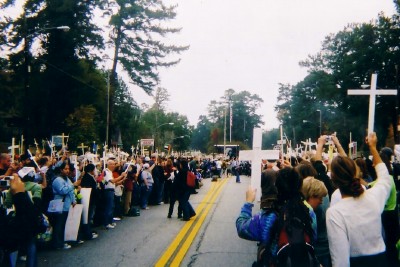 |
| Photo by Patrick Mulvaney of 2004 SOA Protest Funeral Procession Read his recount here |
Yet, outside of a handful of Catholic and Protestant churches, will this protest get any attention this Sunday in our churches? How many churches will remember the victims of our military actions in their prayers of the people? Will there be any special services to commemorate this ongoing suffering tragedy?
I want to contrast this with what I saw earlier this month all over social media, in the news and with my own eyes. On the Sunday before Veterans Day, there were special services, invitations to military families, and prayers for our troops. Here is just one of many examples: Rick Warren's Saddleback Church had a special invitation to military families.
If you're a veteran or currently serving, we'll honor you today at all USA campuses.Invite veterans! pic.twitter.com/XqPuzwVVoB
— Rick Warren (@RickWarren) November 10, 2013
When will Saddleback Church
make a special invitation to peacemakers and their families? Or any
church for that matter?When will churches give prayers for the victims of war in the Prayers of the People? When will we remember the deaths of our fellow Christians or even humans affected by our extremely large military? Even more, when will we recognize that we are all complicit with the military industrial complex that feed off a patriotic Christianity in the United States? This is one of our sins that we need to recognize!
I have seen pastors who are worried about saying anything to disrupt their congregants on Veterans Day weekend. If they didn't want to glorify war, most of them stay silent and did not mention their real beliefs. Veterans Day weekend in the Church should have been one of mourning. Yes, mourning that the War to End All Wars did not do accomplish that. Instead it continued a brutal and violent history. We should mourn how we so eagerly send off young people to fight to keep the Defense Industry wealthy, while we ignore veterans on the streets?
Sadly American Christianity is currently more interested in upholding American Exceptionalism rather than having a prophetic voice. When will we recognize that God does not just love us but the whole world? Until that point, American Christianity will continue to worship America more than God.
Wednesday, October 23, 2013
Thesis Statement
People have been interested in hearing about my thesis. After a little research, here is a better statement describing of where I hope to go with this project. Thank you already for all the help!
I welcome feedback, tips, comments, suggestions, etc... you can email me at gregory.woods(at)ptsem.edu
---
My Masters of Divinity Thesis, being written under the guidance of Professor Mikoski, will focus on re-imaging what short-term church mission trips could be. In this context, I am using short term mission trip to mean a trip primarily for teenagers and young adults going outside of their own community to do hands-on service projects in an economically-disadvantaged population for a short length of time, usually a weekend or a week, no more than two weeks. In its current iteration, these well-meaning trips have been problematic, often serving to reinforce stereotypes of poverty and minorities and establishing a helpee-helper relationship that creates an unhealthy power dynamic and fosters dependence.
My main argument is that these mission trip experiences should be rooted in building interdependent relationships and by creating space for dialogue between groups of people that rarely interact in any meaningful way. Our society is so fragmented that even through we might live in the same geographical place as other people, we rarely engage with others from radically different backgrounds. These projects can serve as a way for us to answer the question that Jesus was asked, "But who is my neighbor?" (Luke 10:29). Yet further these projects can challenge how to fulfill Jesus' second commandment of “Thou shalt love thy neighbor as thyself” (Mark 12:31, Matthew 22:39).
I will argue that a different model could be used. Short-term mission trips could be based on long-term reciprocal relationships that blur the lines between helper and helpee. These kind of relationships would allow for each other's gifts to be shared and appreciated. I will present case studies of existing reciprocal relationships and the best practices learned from these relationships. By presenting these case studies, I hope to further the academic research into these seldom-studied relationships, as well as provide examples for people wanting to start these kinds of relationships.
Throughout the thesis I will draw on my own experiences as a participant and leader of mission trips, recent scholarship and popular works on this topic, interviews with people around the world involved in all facets of mission trips, and the research undertaken last academic year in an independent study by Margaret Webb (PTS MDiv 2013) and me.
---
If you are curious about Margaret and my research from last year, check out this website we built.
I welcome feedback, tips, comments, suggestions, etc... you can email me at gregory.woods(at)ptsem.edu
---
My Masters of Divinity Thesis, being written under the guidance of Professor Mikoski, will focus on re-imaging what short-term church mission trips could be. In this context, I am using short term mission trip to mean a trip primarily for teenagers and young adults going outside of their own community to do hands-on service projects in an economically-disadvantaged population for a short length of time, usually a weekend or a week, no more than two weeks. In its current iteration, these well-meaning trips have been problematic, often serving to reinforce stereotypes of poverty and minorities and establishing a helpee-helper relationship that creates an unhealthy power dynamic and fosters dependence.
My main argument is that these mission trip experiences should be rooted in building interdependent relationships and by creating space for dialogue between groups of people that rarely interact in any meaningful way. Our society is so fragmented that even through we might live in the same geographical place as other people, we rarely engage with others from radically different backgrounds. These projects can serve as a way for us to answer the question that Jesus was asked, "But who is my neighbor?" (Luke 10:29). Yet further these projects can challenge how to fulfill Jesus' second commandment of “Thou shalt love thy neighbor as thyself” (Mark 12:31, Matthew 22:39).
I will argue that a different model could be used. Short-term mission trips could be based on long-term reciprocal relationships that blur the lines between helper and helpee. These kind of relationships would allow for each other's gifts to be shared and appreciated. I will present case studies of existing reciprocal relationships and the best practices learned from these relationships. By presenting these case studies, I hope to further the academic research into these seldom-studied relationships, as well as provide examples for people wanting to start these kinds of relationships.
Throughout the thesis I will draw on my own experiences as a participant and leader of mission trips, recent scholarship and popular works on this topic, interviews with people around the world involved in all facets of mission trips, and the research undertaken last academic year in an independent study by Margaret Webb (PTS MDiv 2013) and me.
---
If you are curious about Margaret and my research from last year, check out this website we built.
Thursday, October 17, 2013
Debate about Teach for America
Yesterday I read a critique of Teach for America on Slate by a former alumna and now Professor of Education.
Today I posted that critique to Facebook. A friend, an employee of TFA, sent me a critique of the Slate article by another employee of TFA, Justin "Juice" Fong. These two articles are getting a lot of comments on my Facebook wall and I want to get in more of a dialogue. I have friends who have done TFA and love it and I have friends who despise it. Please keep it civil.
Below is my critique of Fong's critique:
I have read other posts by Fong before, so I am aware of him and his writings about TFA. Overall I think it is a good critique, but it raises more questions for me.
I am glad TFA is trying to get people to stay past two years. Why not do something bold and make it a five year commitment? I know of a program like that in Chicago. I talk to Princeton students who will go do two years in US and then go to graduate school or law school. They specifically do TFA because it will look good on resumes when they want to apply.
Also I would argue that ending up in an education nonprofit is not the same thing as staying in a classroom teaching. I think that is what the Slate author is implying that people aren't staying in the classroom. I would love to see that data from RI about how many stayed in the actual classroom. Is it half of 70%? Or 3/4th? What will it look like in 10 years? What is TFA's goal for retention? Fong himself 10 years later isn't in a classroom. So are disadvantaged students supposed to accept having a new teacher their whole school career, just because they go to a school with a lot of TFA staff and turnover because of it?
Another critique that I have heard and the Slate author alluded to is that TFA is more interested in Ivy League and top private school students than public school students. What are the stats? Yes it is good that the corps are getting more diverse but where are they coming from? Lets talk about the differences in privilege of a Ivy League student compared to a public university student. Also how many are education majors? Seeing posters around my college back in 2007, I received the impression that they wanted everyone besides education majors?
When a school district is downsizes, does TFA downsizes its corps accordingly? Or are long term teachers losing their jobs to TFA members? What is TFA doing in Chicago, for example? (My friend at TFA responded that some Corps members did lose their jobs as well as alumni in both Chicago and Philadelphia.) Is TFA sending less corps members there because of that, so there is room for new teachers who have MATs who want to teach there?
What about the Slate author proposal of having TFA members be co-teachers with a veteran teacher or teaching assistants for the first year? Wouldn't that help members receive more training and students to have an incredible education experience.
I think it is sad for Fong to compare SAT scores of Education majors with college GPA of TFA members. Really that is not the same comparison at all. So no one can be a good teacher if they didn't do well on a test in high school? One of my teachers in high school didn't complete college until late in life (if she ever did), but damn she was one of my best teachers ever and had other teachers' respect. Over my life, committed teachers have help me more and they probably were not always the top of their college class. Yes it would help to have more smart teachers, but I would want teachers who are passionate for the job too and in it for the long haul.
What do you think? Hopefully Juice will answer some of my questions because I would like to hear his responses.
Today I posted that critique to Facebook. A friend, an employee of TFA, sent me a critique of the Slate article by another employee of TFA, Justin "Juice" Fong. These two articles are getting a lot of comments on my Facebook wall and I want to get in more of a dialogue. I have friends who have done TFA and love it and I have friends who despise it. Please keep it civil.
Below is my critique of Fong's critique:
I have read other posts by Fong before, so I am aware of him and his writings about TFA. Overall I think it is a good critique, but it raises more questions for me.
I am glad TFA is trying to get people to stay past two years. Why not do something bold and make it a five year commitment? I know of a program like that in Chicago. I talk to Princeton students who will go do two years in US and then go to graduate school or law school. They specifically do TFA because it will look good on resumes when they want to apply.
Also I would argue that ending up in an education nonprofit is not the same thing as staying in a classroom teaching. I think that is what the Slate author is implying that people aren't staying in the classroom. I would love to see that data from RI about how many stayed in the actual classroom. Is it half of 70%? Or 3/4th? What will it look like in 10 years? What is TFA's goal for retention? Fong himself 10 years later isn't in a classroom. So are disadvantaged students supposed to accept having a new teacher their whole school career, just because they go to a school with a lot of TFA staff and turnover because of it?
Another critique that I have heard and the Slate author alluded to is that TFA is more interested in Ivy League and top private school students than public school students. What are the stats? Yes it is good that the corps are getting more diverse but where are they coming from? Lets talk about the differences in privilege of a Ivy League student compared to a public university student. Also how many are education majors? Seeing posters around my college back in 2007, I received the impression that they wanted everyone besides education majors?
When a school district is downsizes, does TFA downsizes its corps accordingly? Or are long term teachers losing their jobs to TFA members? What is TFA doing in Chicago, for example? (My friend at TFA responded that some Corps members did lose their jobs as well as alumni in both Chicago and Philadelphia.) Is TFA sending less corps members there because of that, so there is room for new teachers who have MATs who want to teach there?
What about the Slate author proposal of having TFA members be co-teachers with a veteran teacher or teaching assistants for the first year? Wouldn't that help members receive more training and students to have an incredible education experience.
I think it is sad for Fong to compare SAT scores of Education majors with college GPA of TFA members. Really that is not the same comparison at all. So no one can be a good teacher if they didn't do well on a test in high school? One of my teachers in high school didn't complete college until late in life (if she ever did), but damn she was one of my best teachers ever and had other teachers' respect. Over my life, committed teachers have help me more and they probably were not always the top of their college class. Yes it would help to have more smart teachers, but I would want teachers who are passionate for the job too and in it for the long haul.
What do you think? Hopefully Juice will answer some of my questions because I would like to hear his responses.
Tuesday, July 2, 2013
The Need for Intimacy in Quaker Worship
I wrote this piece for The Canadian Friend Summer Youth Issue, which is being mailed to Friends across Canada and beyond this week.
Do
we know our fellow worshippers? Do we know the people with whom we
are filling Christ's request for His presence in the Book of Matthew
chapter 18? Christ says in 18:20, " For
where two or three are gathered in my name, I am there among them"
 |
| The Canadian Friend Summer Issue Cover |
Often
our monthly meetings do not function as a close caring group of
Friends. I
attended a large meeting for well over a year and one day during
worship I looked around the room to count the names of people who
were there. Even though I attended regularly and was active in
organizing the Young Adult Friends, I was embarrassed that I only
knew half of the names of the people gathered that day. After
attending another Meeting regularly for six months, I was called by a
member of the Outreach committee and was asked if I was still
attending worship. Even though I have a more positive experience with
this particular monthly meeting and had knew most of the community, I
had never met the caller. Furthermore when I asked the clerk of the
meeting if she could point out the person, she could not recall who
this woman was.
Recently,
I read an article in Friends Journal recommending that the
Religious Society of Friends talk about having a testimony of
intimacy. I agree with the need to talk about intimacy in our
community, but this Friend referred only to sexual intimacy.
I
utterly reject using intimacy to mean only romantic relationships. By
relegating this word to just mean one kind of relationships, to mean
just one of its definitions, we are losing a valuable aspect of our
community. When worshipping together was considered a criminal act,
early Quakers know what being intimate with each other meant. Then
during our Society's isolationist period - in the eighteenth and
nineteenth centuries - when Quakers lived in their own communities
away from others, they knew each other and set up ways to monitor
each other. This is why we have traveling minutes and marriage
certificates. Both of these traditions were introduce partly as ways
to watch over people to make sure that our collective faith stayed
pure. Friends were definitely involved with each other in an intimate
manner.
I
am definitely not arguing that we go back to our isolationist period,
but our spiritual ancestors definitely knew who they worship with
every First Day. Do we? Can you name everyone in Meeting on Sunday?
If so, do you know what their recent struggles and triumphs are?
Quakers
do not believe in outward forms of sacraments. Rather, we believe in
sharing the holy communion inwardly with each other. Through waiting
worship should be offering each other the proverbial bread and wine.
It is a communal experience. If it isn't, why do we gather each week?
Why pay for the upkeep of our Meeting Houses? Instead we could just
stay at home and mediate alone. Sharing God's body with fellow
worshippers each Sunday is an intimate act. Do we treat each meeting
for worship as a sacred time? Do we come to meeting for worship
expecting to be changed through this weekly time for sharing inward
sacraments with each other?
One
of my favorite meeting for worships happened in the aftermath of
Superstorm Sandy that hit the eastern coast of the US last October.
The Sunday after Sandy hit, the Meeting House was still without
electricity. Yet we gathered on a rather cold morning. We huddled
together around the fireplace for an hour of waiting worship. Our
bodies were touching as well as our souls as we gathered in God's
presence. That day, I felt a part of this worshipping community in a
whole new way.
By
the next Sunday, the electricity to the Meeting House was restored
and we returned to our usual seating pattern spread throughout the
room, with two or three on a pew, instead of a dozen. The only people
who sat close together were couples and families. Months later I
still miss the intimacy I felt that one cold Sunday morning as we
huddle together simultaneously seeking the warmth of the fire and the
Holy Spirit.
How
can we reclaim intimacy within our faith community, before we just
become strangers who gather together for personal time of mediation?
Saturday, May 25, 2013
Lets Stop Glorifying War in Church
This weekend, we are celebrating
Memorial Day. In the last week, as I have passed churches on the road
and seen their Facebook updates, I have seen a lot of messages that
says something about honoring our heroes. Each time I read or see
that, I cringe. It is further evidence of the combining Christianity
and patriotism in this country. The Early Church gathered in secret
to worship a Savior that was executed by the most powerful military
at the time, but now we worship the most powerful country and its
military strength along with Christ. There are a lot of dangers in
this continued Idol worship.
The influential German theologian Karl
Barth was perturbed as a young man when his clergy mentors and other
prominent Germans signed the Manifesto of the Ninety-Three in 1914.
This manifesto offered unequivocal support of the actions of the
German military. This had a major effect on Barth's theology about
the separation of the church and the government. When a professor
talked about this pivotal moment in Barth's life and theology last
semester during a class on Karl Barth, he did not even attempt to
make the connection between Barth's crisis to the current dilemma
that we face in this country. Tomorrow, thousands, perhaps millions
of US Christians will walk into their churches and not be surprised
to see the American flag near the altar.
I have been thinking about this
dilemma for a while. Growing up, I attended anti-death penalty vigils
outside of my state's Governor Mansion. In reading about the cases, I
sometimes learned that the death row inmates have served in the armed
forces at some point before their crime. Often I reflected on this
double standard, we teach people how to kill people and then praise
them, but then we will also put to death the same people if they kill
other people. How does any of this fits in Christ's admonishment that
we should love our neighbors?
Last May I took a short intensive
class on Young Adult Ministries. As part of this class, we talked
about ministries in university settings, prisons, and the military.
To talk about military chaplainships, the class traveled down to
Washington DC and talked to chaplains currently serving in different
parts of the armed forces. Several of us asked most of the chaplains
how they dealt with the command from Christ to love our neighbors.
All but one chaplain did not answer this question. Usually they
responded with that they are just following orders or altogether
avoid the question. The one chaplain who actually answered the
question said that it was a hard question and one that some soldiers
had a hard time wrestling with.
As a Christian, when I am in church,
my allegiance is only towards Christ. I do not believe that God only
blesses the USA, instead I believe God loves the whole world. I do
not buy into a philosophy that is the outgrowth of the Manifest
Destiny that led to the unnecessary slaughter, slavery and death of
millions of Native people. I do not buy into a philosophy that was
used to justify slavery in this country and around the world. I
believed that we are called to love our neighbors period.
By writing this, I do not want Christians to abandon our troops. We should dialogue
about what it means to support our troops and how to support these
men and women after they return home, changed forever. We should also
hold up the people who go to the same regions to do purely
humanitarian work, often unarmed and with less support, in an effort
to bring about peace in other ways. But at the same time lets not
glorify the world's richest military within our church doors. We
already do that enough the other six days of week.
Instead, on this Memorial Day weekend and
after, let's keep Church as a place to remember the human costs of
the war (including all casualties of war) and our own implicitness in
this industry that keeps us at war. Let's pray that God will keep
giving us strength to work towards an eternal peace that will only
exist when God's Kingdom come into being.
Thursday, May 16, 2013
Not Letting Myself Be Defined By My Speech Or My Beard
Earlier today I went to a barbershop
downtown and had my beard greatly trimmed and received a nice hair
cut as well. Part of the reason I had to do this is that I am doing a
Clinical Pastoral Education (CPE) at a nearby hospital. This
basically means I will be the hospital chaplain's intern for the
summer. When I interviewed back in the fall, the chaplain informed me
that for health reasons that I would have to cut most of my beard
off.

 ll the baggage that comes with that.
With a long beard I felt defined in another way. It was like my
security blanket. I thought maybe people will remember me as the guy
with the really rad red beard, instead of the guy with the speech
impediment. But, also I did get a lot of snickers and laughs coming
at me because I had a ridiculously long red beard. Sometimes, like my
speech impediment, I felt embarrassed by having this long beard.
ll the baggage that comes with that.
With a long beard I felt defined in another way. It was like my
security blanket. I thought maybe people will remember me as the guy
with the really rad red beard, instead of the guy with the speech
impediment. But, also I did get a lot of snickers and laughs coming
at me because I had a ridiculously long red beard. Sometimes, like my
speech impediment, I felt embarrassed by having this long beard.
Ever since I was young, I have wanted
a beard. I do not know exactly why, but I do remember wanting one as
early as middle school. Then when I was 18 I grew my first beard and
for a good portion of the last ten years I have had a beard in some
form. At times, I have kept it trimmed in a way but for almost the
last two years I have just let it grow with very minor trims. I
mainly did out of curiosity to see how long it grew. But I did it
unconsciously for another reason too.

In therapy, as I have written aboutbefore on my blog, I have been dealing with my self image. For most
of my life, I have felt that my speech impediment has been my most
defining characteristic. I thought the way I speak is how people
remember me the most and it was usually the only quality most people
would notice. But some friends told me that this was not case. Once I
wrote an email to someone who had met a couple years before at a
conference. She had not remember me, so I said that I had red hair
and a speech impediment. She emailed back to let me know that she did
remember me but she remember me for other qualities than my speech
impediment.
I think this was the first time I
realized that I should not let myself be defined by my speech
impediment. But it is hard not to let it be, especially after a
couple decades of telling myself that I am defined by my speech. To
be honest, I have to deal with people not being able to understand me
everyday and I have to deal with some of those people automatically
assuming that I am mentally handicapped in a way most days.
Yet, with a long red beard, I would
get noticed before I even opened my mouth. People everywhere
complimented me on the beard. I stood out in another way than just
having a speech impediment and a

As I thought about this dilemma in
therapy, I realized that neither my long red beard or having a speech
impediment completely define who I am. I have a lot of other
characteristics, much more important aspects of myself. If I let
myself be define by either of these two qualities, I am holding back
my gifts that I can offer the wider world. Even though I will always
be defined negatively by an handful of people (it can be a cruel
world out there), I have to remember that I am a child of God and I
need to live into that role more fully. In Matthew, Jesus commands in
the Sermon on the Mount that, instead of hiding it under a bushel,
everyone should let their light shine (Matt 5:15-16).
Yes, I do need to let my light shine
brightly and not hold my gifts from the world.
Friday, April 12, 2013
Reflections from My Lenten Journey with Anger
The
Lenten season has ended, but my journey with anger is just getting
deeper. Over the Lenten season, I thought about: How deep my self-hate
actually is; why I root for underdogs; and How I may unknowingly
discriminate against others.
During the Lenten season, I began to really grapple with how deep my self-hate goes. I wrote about this in my first blog post,
but at that time I did not know just how deep it is and how I have held
a grudge against myself. Upon this realization, I thought that if I
just started to love myself the self-hate would magically disappear...
Sadly,
it does not work that way. By focusing on my self hate more during the
Lenten season through therapy, writing, and mediation, I was able to
explore how I have internalized people's opinions of myself since a
young age. I have sought outside reinforcement of my worth because I do
not have a high opinion of myself. I thought I would gain this through
other means, but I never have. As I have discovered through the Lenten
season, no outside reinforcement has been enough to build a sense of
self-worth, it ultimately has to come from me and me alone.
For
most of my life, I have been active in helping others and advocating
for social justice. I always thought it had to do solely because of my
Quaker upbringing. But during Lent, I reflected more on this. In late
February the poet Shane Koyczan released a video of the slam poem "To This Day" and it made its rounds across the internet. Then in early March his TED talk was
released as well. I have listened to the poem several times and his TED
talk once. His words connected deeply to my experiences growing up
feeling out of place and why I root for the underdog. If I believe that
the underdogs would never win, I would never have a chance. I always
thought if they could win, I could win. I am still working through this
realization and how it has impacted my life and my outlook on life.
Thinking about this "underdog" mentality also reminded me of the movie, Simon Birch,
which I saw years ago. At the end of the movie when the title
character dies, everyone else reflects on what lessons they had received
from him and his tragic circumstances. This is how people, usually
children, with disabilities are portrayed in popular culture as being
here solely so that other people can learn valuable lessons. Afterwards
they are promptly discarded or ignored. They are not to be recognized as
regular human beings with the same desires and feelings, instead they
have a mythical presence. This might be because people with disabilities
are largely ignored or avoided in the real world.
Society
largely does not know what to do with adults living with disabilities.
As kids, at least society will raise money and make movies about us. As
adults, we are often left alone and the discrimination just gets worse.
Another famous example is Helen Keller. Most people learn about her
childhood and about her teacher, Anne Sullivan. But did you know that as
an adult she graduated from college and became a socialist activist,
fighting for human rights? We all like the story of Helen overcoming her
disabilities to communicate, but we never hear the rest of the story of
how she used her communication skills to advocate for others.
Shane’s
poem also raised up the subtle ways my teachers and friends compounded
my self-hate and discriminated against me with their use of words and
their actions. Realizing how language and actions impacted me has made
me wonder how I might discriminate against others with my words and
acts. Now I am looking at what I say and how I act towards others. I
have explored how I treat people and the words I use. In a recent
sermon, I explored the concepts of Light and Darkness. This is just the beginning of that process in exploring ways I might have discriminated against other.
I
did not write a lot during the forty days but I hope to continue to
write and to develop something for children growing up with disabilities
and their families and friends. I continue to welcome anyone who wants
to dialogue on any of these topics. This journey will continue as my
journey with God and Christ continues after the end of Lent.
Wednesday, March 27, 2013
Light and Darkness Become One
I preached this sermon this morning in my preaching class based on some thoughts that I have been mulling over in the last week about the use of the word, "Light" among Quakers.
This sermon is based on Jonah 1:17-2:10 (NRSV)
In the Quaker tradition, we use the metaphor of the Light a lot. Partly because early Quakers use this imagery often in their writing and also partly some Quakers are uncomfortable with using the word "God". Most of them tend to be spiritual refugees from other denominations, having grown up being told that God did not love them for one reason or another. Some tried to hide their true selves from God and others, feeling like if others knew the insides of their souls, they would be disowned forever by God and the church. Now to them Light seems safe to say because it is a new metaphor to them, something different, something without baggage.
This sermon is based on Jonah 1:17-2:10 (NRSV)
In the Quaker tradition, we use the metaphor of the Light a lot. Partly because early Quakers use this imagery often in their writing and also partly some Quakers are uncomfortable with using the word "God". Most of them tend to be spiritual refugees from other denominations, having grown up being told that God did not love them for one reason or another. Some tried to hide their true selves from God and others, feeling like if others knew the insides of their souls, they would be disowned forever by God and the church. Now to them Light seems safe to say because it is a new metaphor to them, something different, something without baggage.
But
I have been reflecting on what I have been using for the opposite of
Light for most of my life, which is usually darkness, to describe a
lack of God, evil. I started rethinking using darkness to describe
the opposite of Light last semester when I read a quote from Rev. Dr.
Martin Luther King Jr. In an address in 1967 Dr. King said, "In
Roget's Thesaurus there are some 120 synonyms for blackness and at
least sixty of them are offensive, such words as blot, soot, grim,
devil, and foul. And there are some 134 synonyms for whiteness and
all are favorable, expressed in such words as purity, cleanliness,
chastity, and innocence." Ever since then, I have been
wondering: Do I promote this negative duality through the way I talk
about my spirituality? Light/White = good and Darkness/Black=bad.
To
seek out guidance on how I should proceed with this question, I went
to the wisest place I know of for answers. Facebook!
Several
friends commented. A friend bought up the ideas of an UU theologian
Jacqui James who writes that there are some good points about
darkness, like it brings relief from the scorching heat. Also in
darkness seeds begin to sprout and thus new life begins. Another
friend brought up the story of Jonah being in the whale. Jonah
had to go through the darkness within a fish to accept his call. As
we heard from the passage, in the darkness, Jonah says a praise of
thanksgiving to God, before the fish throws him up onto the land.
Before
this praise of Thanksgiving, Jonah has tried his best to avoid
accepting the call from God to go to Ninevah. As we hear in the
praise, he had to be close to death before he realized the entire
positives in his life and how much he believes in God. But we know
from the passage that he was not actually near death because God sent
the fish to shallow him before he drowned to the depths of the ocean.
God protects him, even though he acts disobediently when God calls
him. Jonah is not the only prophet he tries to hide from God. Oh no!
I bet
some of us have stories of being disobedient towards God's calling to
come to be here today listening to this story. Heck, you probably
wanted to be disobedient and did not want to get out of bed this
morning. I know I did.
For me
the journey of coming to seminary took me to rural Missouri. I had
heard the calling before I moved to rural Missouri from Washington
DC, but I ignored the call. I was always too busy or too poor to go
to seminary, or I thought. I kept saying no to seminary, thinking
another opportunity, in the form of a job or anything else, was
around the corner. But it took me asking God late at night alone what
the next plans God had for me. It took doors closing before I said
yes to God's calling. I thought I was spiraling downwards but now I
know that God was leading me here by taking me to those dark cold
nights in Missouri. Now I am thankful for those cold dark nights
wondering where I would go next.
As
future pastors and leaders of the church, we will be charged with
helping people of all ages as they go through terrible parts of their
lives. Some things we will see will be horrible. But sometimes we
will see our parishioners struggle and they will actually be rebirths
into Christ and deeper faithfulness. There will be times where we
will go through difficult times in our own lives too. But the good
news, just like Jonah in the fish, we are not alone. God will always
be watching over us and this process.
Also I
think this is where the church that we are inheriting is right now.
Many people think the church is dying. All the signs are there.
Attendance is down across the board in the mainline denominations.
Churches are often in the red, only surviving off of endowments from
past generations. There are more pastors looking for positions than
open positions. Most of us are going to graduate without an assurance
of a job.
But in
the midst of this struggle, there is a hope, a seed, a thanksgiving
to be seen. We are seeing the church changing. LGBTQ people are being
accepted in as the children of God as they have always been. The
church is becoming more than just a building that is open on Sunday
to only some. There are so many examples of pastors and Christians
taking new risks, trusting on God, doing and being in the Church in
radical new ways because we cannot do any worse than we are right
now. A couple weeks ago we listened to Dean Kay preach about his
former church in Minnesota which changed themselves into a new kind
of church with an active laity outreach to the community. We live in
a time of great hope of pastor being bold. The church is being reborn
and we are involved with this process.
Finally,
this Sunday we will celebrate women finding an empty tomb and a
command for them to tell the world about their find. In this dark
cave, a place of death and sadness, God gave a people a message of
hope that has lasted over 2,000 years, the resurrection of Christ and
a proclamation of freedom to the captives. Light and darkness became
whole together in that tomb with Christ's Resurrection. This act
confirms God's devotion to all, despite what some people may try to
say. By putting Jonah in a fish and by making a sealed cave empty,
God shows that God does love all!
Sunday, March 17, 2013
The Unpredictability of March
A
couple weeks ago, I attended the meeting for worship at Princeton Friends School, which the school calls "Settling In". Each
week they meet for 30 minutes and a student offers a query. Since it
was the first day of March, the assigned student asked "What are
you looking forward to in March?"
One of the teachers stood up and talked about how March could bring different weather. In March it is still normal for there to be a late snowstorm he said, but we also could expect sunny days to happen where short sleeves can be worn and bike riding could be done. The theme of his message was that March brought unpredictability, at a time when we wanted something concrete, ie the end of Winter and the start of Spring or the end of one stage of life and the becoming of another. We know that Spring is coming and we will hear about where we go on the next stage of our life, but March always brings surprises and bumps along the way.
But that was not always true. Once I remember arriving to the airport in DC when it was in the 70s there. Instead of the group all wearing shorts and T-shirts in preparation for warm weather to follow us, we were carrying jackets and coats while wearing jeans. I actually expressed concern for two students who arrived with shorts on. "Did you come prepared? Did you look at the weather forecast?" Once we landed in New Orleans, it was a different than other years. It was cloudy with a high in the upper 40s. That night the temps dipped down to about freezing. We were cold that night sleeping in the not well insulated dorm room. It did warm up by the end of the week, but it seemed strange.
---
A week later after the Settling In worship, I was reminded of the teacher's words. A small snowstorm dumped a couple inches on Princeton, ruining any plans for bicycling or playing outside. It was beautiful and Princeton looked more like it was early January than early March. Jenn and I would have appreciated the snow more if we weren't in a hurry to make it to DC. We left that morning instead of the night before due to forecasts of snow. Yet, despite the weather forecasters' predictions, the snow came that morning.
The unpredictability of March caught us and we were not prepared or happy. We were worried that we were going to be late. Even though we knew it would clear up as we headed south, we were still worried in the moment. We knew that we needed to just keep driving until we were out of the storm
Students
talked about upcoming birthdays, looking forward to playing outside
more, and summer coming closer. They were ready to shed their winter
clothes and activities for sunny days spent outside. Eighth graders
expected to hear back from high schools soon and they were nervous
and eager to find out where they were accepted. These students were
eager to take the next step in their education and life.
One of the teachers stood up and talked about how March could bring different weather. In March it is still normal for there to be a late snowstorm he said, but we also could expect sunny days to happen where short sleeves can be worn and bike riding could be done. The theme of his message was that March brought unpredictability, at a time when we wanted something concrete, ie the end of Winter and the start of Spring or the end of one stage of life and the becoming of another. We know that Spring is coming and we will hear about where we go on the next stage of our life, but March always brings surprises and bumps along the way.
---
In
my experience this rang true. I used to go to New Orleans in March
from Washington DC with a group of high school students for an
alternative spring break trip. I remember often times bundling up to
go to the airport in DC and then shedding all the layers once we
landed in New Orleans. New Orleans was usually sunny with highs in
the 70s and 80s that week in March. It gave us our first glimpse of
Spring that helped us make it through the last few weeks of a DC
winter/early Spring when we returned home. We were given a chance to
see what was awaiting us once we waited out the dreadful last weeks
of the winter season.
But that was not always true. Once I remember arriving to the airport in DC when it was in the 70s there. Instead of the group all wearing shorts and T-shirts in preparation for warm weather to follow us, we were carrying jackets and coats while wearing jeans. I actually expressed concern for two students who arrived with shorts on. "Did you come prepared? Did you look at the weather forecast?" Once we landed in New Orleans, it was a different than other years. It was cloudy with a high in the upper 40s. That night the temps dipped down to about freezing. We were cold that night sleeping in the not well insulated dorm room. It did warm up by the end of the week, but it seemed strange.
---
A week later after the Settling In worship, I was reminded of the teacher's words. A small snowstorm dumped a couple inches on Princeton, ruining any plans for bicycling or playing outside. It was beautiful and Princeton looked more like it was early January than early March. Jenn and I would have appreciated the snow more if we weren't in a hurry to make it to DC. We left that morning instead of the night before due to forecasts of snow. Yet, despite the weather forecasters' predictions, the snow came that morning.
The unpredictability of March caught us and we were not prepared or happy. We were worried that we were going to be late. Even though we knew it would clear up as we headed south, we were still worried in the moment. We knew that we needed to just keep driving until we were out of the storm
---
I
feel like being a religious seeker is living perpetually in a state
of March. Hopefully most of us have made it through the long journey
towards God, the Light, the Holy Spirit. We know that we are almost
there to the glory and unlocking the mystery, but we are not there
just yet. Instead we will encounter a little more doubt and weariness
and we will encounter quick fixes that promises happiness sooner than
later. Sometimes I feel like that this time is harder than the
journey I experienced at my lowest point in time. I am ready for the
low point to be over. I am ready for God! That thought, much like
looking forward to sunny days during a late winter snowstorm, keep me
going in my faith.
Thursday, February 21, 2013
Living Water is Available to All
I wrote this for my preaching class at Princeton Theological Seminary and I preached it this week. I wrote it with my classmates in mind, but it is a message for everyone to hear.
The scripture is John 4:1-26
When I was nine years old, I went to an annual family church camp that we went to every summer. One afternoon I was hanging out with some slightly older kids at the camp. The only reason I clearly remember my age is because the older kids wanted to go on a walk without me, so they told me that only people who were double digits in age could go on that particular walk. I was disappointed. I remember thinking, "But I will turn 10 in two months," as they went walking away and I was left out of a cool adventure: Going to the railroad tracks to throw rocks. I was outcasted because of something so trivial as my age, something I couldn't change about myself.
Often times I feel that is how the church feels to outcasts in our communities, even if we try to deny it. We say everyone is welcomed, but really is everyone welcomed at our churches? Would the town outcast be welcomed at your church like any other person? How would we end up acting if a woman, who reeks of cat odors, comes in for the 11 o'clock service? Would we give her the same time or attention that we give the matriarch of the family who comes to church each Sunday and sit in the fifth bench? Do we openly invite these people in and offer them grace?
In the scripture, we just heard, Jesus shows us what it means to really invite someone into the church. He offers grace and the Living water to a Samaritan woman. She is an outcast and we do not exactly know why she is an outcast. But she is at the well at a rather unusual time. We know that she has had many husbands, so that may be a reason. Maybe this town was her husbands' family town and the family despises her now that her husbands are gone. Let just say dealing with in-laws is not always easy, right? Whatever happened to her, it is clear that she is not part of the in-crowd in this small town. She has internalized this: Why would anyone want to have anything to do with me, much less a stranger hanging out by the well?
This Lenten season I have devoted myself to writing about my anger and with the source of this anger. Through therapy over the last year, I have found out that I have had a lot of anger towards God and Christianity. Growing up I was picked on by Christians and saw others being picked on by Christians. "Why did God let this happen?" I thought. Their actions didn't look like God's Love to me. I started to internalize the taunts and the mistreatment I faced. I thought that God hated me and gave me this impediment for some sort of misdeed I did in a past life. Why else would God give me a speech impairment? Why else would God do this to a kid? I remember crying at night when I was young and saying, "Why me? Why God?" just wanting a clear answer yet never receiving one. I felt like the Samaritan woman at the well. I felt outcasted.
In the last year, I have realized that, even through the painful times, God was/is always with me. I stand here today bringing the word of the Lord by God's grace alone. There were times, I thought about leaving the faith. During these dark times, I doubted myself and what I had to offer the world. There were times when I couldn't feel loved by anyone, but now I know that God and my family always loved me. They all loved me even when I was a difficult person to be around, in the midst of an angry rage. When I felt alone, the Living Water was still available to me. God did not give up on me because, like the woman at the well, I did not immediately understand what God was offering me through Jesus. God was still there when I decided to come back and accept what was being offered to me. Now I do not wonder why I am the way I am. I see my life as a gift, not a daily burden. I have stumbled along the path to God, but God has always been waiting to receive me.
Jesus shows us that the living water is available to all that seek, to all despite who they are, even if they are an outcast or feel outcasted. Before this scene in the Gospel of John, Jesus had only encountered other Jews and the disciples did not fully grasp how far Jesus' grace extended. After this scene with the woman at the well, the disciples are surprised, "What are you doing, Jesus, with that woman? We went to get some meat and now you are talking to an outcast?" Jesus was showing them and is showing us through His actions that Love, Grace, and the Living Water are available to all, not just a select group at a select time. It is available to people we meet in everyday life, whether it is in a church, at a well, on the street, or in the check-out line, even if they are the worst sinner. If they ask for forgiveness or the Living Water, it is always available to them. Even if they do not understand at first, what is being offered, it is still available to them. Jesus could have left the woman at the well after her first misunderstanding by saying, "I give up! Bye! That was your only chance." But Jesus does not give up, He remains there with the woman in her time of need and continues to offer a new path for her. God has offered us that same thing time and time again. Do we have that kind of patience for others?
That is the good news! The Living Water is always available to anyone who thirst, anyone, despite their pasts, despite our misdeeds. Although our churches can often function like a social clique, where only certain people are welcomed, we can change this. We can reform the church with our leadership saying that anyone and everyone is welcomed. We can choose to treat everyone like they are a child of God. Jesus shows us in the Gospel of John that the Living Water is open to all, who thirst, not just the privileged, or the morally righteous or even the people whose ages are in the double digits.
In our future lives we need to be asking ourselves: How can we spread this vital message in our ministries? How can we change our churches to better reflect Jesus' message at the well, that everyone is welcomed for a drink, no matter what. The church needs to make this change and we are the ones God have called to this path. If we allow ourselves to be God's implement, God will use us to continue offering the Living Water to everyone who wants it. Just as Jesus sends out the Samaritan woman to go tell all about what happened at the well, God is sending us out to tell all about God's love and forgiveness that is available to anyone.
Are we ready for this challenge?
The scripture is John 4:1-26
When I was nine years old, I went to an annual family church camp that we went to every summer. One afternoon I was hanging out with some slightly older kids at the camp. The only reason I clearly remember my age is because the older kids wanted to go on a walk without me, so they told me that only people who were double digits in age could go on that particular walk. I was disappointed. I remember thinking, "But I will turn 10 in two months," as they went walking away and I was left out of a cool adventure: Going to the railroad tracks to throw rocks. I was outcasted because of something so trivial as my age, something I couldn't change about myself.
Often times I feel that is how the church feels to outcasts in our communities, even if we try to deny it. We say everyone is welcomed, but really is everyone welcomed at our churches? Would the town outcast be welcomed at your church like any other person? How would we end up acting if a woman, who reeks of cat odors, comes in for the 11 o'clock service? Would we give her the same time or attention that we give the matriarch of the family who comes to church each Sunday and sit in the fifth bench? Do we openly invite these people in and offer them grace?
In the scripture, we just heard, Jesus shows us what it means to really invite someone into the church. He offers grace and the Living water to a Samaritan woman. She is an outcast and we do not exactly know why she is an outcast. But she is at the well at a rather unusual time. We know that she has had many husbands, so that may be a reason. Maybe this town was her husbands' family town and the family despises her now that her husbands are gone. Let just say dealing with in-laws is not always easy, right? Whatever happened to her, it is clear that she is not part of the in-crowd in this small town. She has internalized this: Why would anyone want to have anything to do with me, much less a stranger hanging out by the well?
This Lenten season I have devoted myself to writing about my anger and with the source of this anger. Through therapy over the last year, I have found out that I have had a lot of anger towards God and Christianity. Growing up I was picked on by Christians and saw others being picked on by Christians. "Why did God let this happen?" I thought. Their actions didn't look like God's Love to me. I started to internalize the taunts and the mistreatment I faced. I thought that God hated me and gave me this impediment for some sort of misdeed I did in a past life. Why else would God give me a speech impairment? Why else would God do this to a kid? I remember crying at night when I was young and saying, "Why me? Why God?" just wanting a clear answer yet never receiving one. I felt like the Samaritan woman at the well. I felt outcasted.
In the last year, I have realized that, even through the painful times, God was/is always with me. I stand here today bringing the word of the Lord by God's grace alone. There were times, I thought about leaving the faith. During these dark times, I doubted myself and what I had to offer the world. There were times when I couldn't feel loved by anyone, but now I know that God and my family always loved me. They all loved me even when I was a difficult person to be around, in the midst of an angry rage. When I felt alone, the Living Water was still available to me. God did not give up on me because, like the woman at the well, I did not immediately understand what God was offering me through Jesus. God was still there when I decided to come back and accept what was being offered to me. Now I do not wonder why I am the way I am. I see my life as a gift, not a daily burden. I have stumbled along the path to God, but God has always been waiting to receive me.
Jesus shows us that the living water is available to all that seek, to all despite who they are, even if they are an outcast or feel outcasted. Before this scene in the Gospel of John, Jesus had only encountered other Jews and the disciples did not fully grasp how far Jesus' grace extended. After this scene with the woman at the well, the disciples are surprised, "What are you doing, Jesus, with that woman? We went to get some meat and now you are talking to an outcast?" Jesus was showing them and is showing us through His actions that Love, Grace, and the Living Water are available to all, not just a select group at a select time. It is available to people we meet in everyday life, whether it is in a church, at a well, on the street, or in the check-out line, even if they are the worst sinner. If they ask for forgiveness or the Living Water, it is always available to them. Even if they do not understand at first, what is being offered, it is still available to them. Jesus could have left the woman at the well after her first misunderstanding by saying, "I give up! Bye! That was your only chance." But Jesus does not give up, He remains there with the woman in her time of need and continues to offer a new path for her. God has offered us that same thing time and time again. Do we have that kind of patience for others?
That is the good news! The Living Water is always available to anyone who thirst, anyone, despite their pasts, despite our misdeeds. Although our churches can often function like a social clique, where only certain people are welcomed, we can change this. We can reform the church with our leadership saying that anyone and everyone is welcomed. We can choose to treat everyone like they are a child of God. Jesus shows us in the Gospel of John that the Living Water is open to all, who thirst, not just the privileged, or the morally righteous or even the people whose ages are in the double digits.
In our future lives we need to be asking ourselves: How can we spread this vital message in our ministries? How can we change our churches to better reflect Jesus' message at the well, that everyone is welcomed for a drink, no matter what. The church needs to make this change and we are the ones God have called to this path. If we allow ourselves to be God's implement, God will use us to continue offering the Living Water to everyone who wants it. Just as Jesus sends out the Samaritan woman to go tell all about what happened at the well, God is sending us out to tell all about God's love and forgiveness that is available to anyone.
Are we ready for this challenge?
Subscribe to:
Posts (Atom)